

Our sea trips departing from Marseille
Tour of the Calanques from Marseille to Cassis
From the Vieux-Port in Marseille, we cross the southern bay to the gateway of the Calanques.
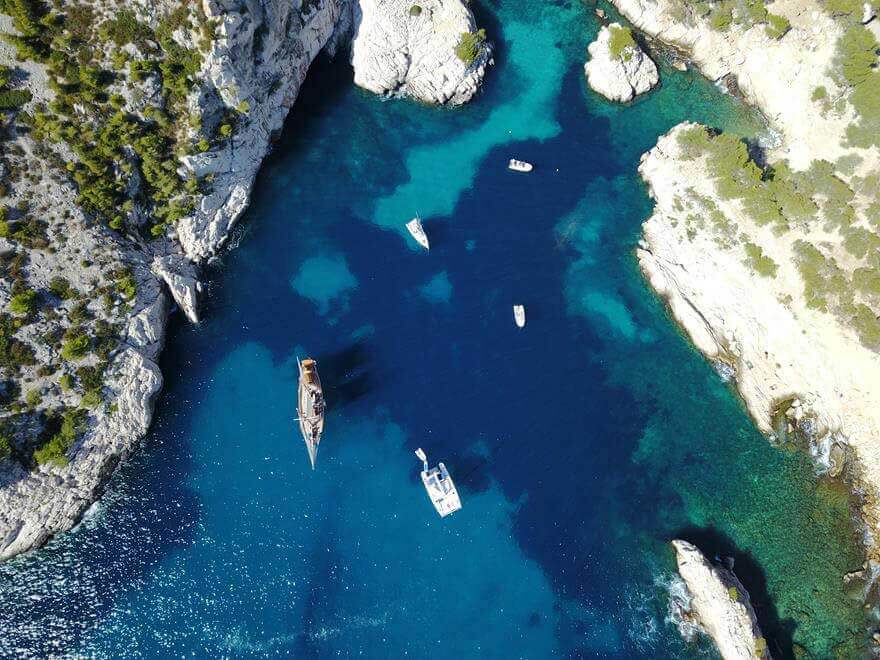
The "Baie des Singes" (Bay of Monkeys) is a natural passage of exceptional beauty between Île Maïre and Cap Croisette. Here, our tour continues through a natural setting, sailing just as the first navigators once did, discovering new horizons.
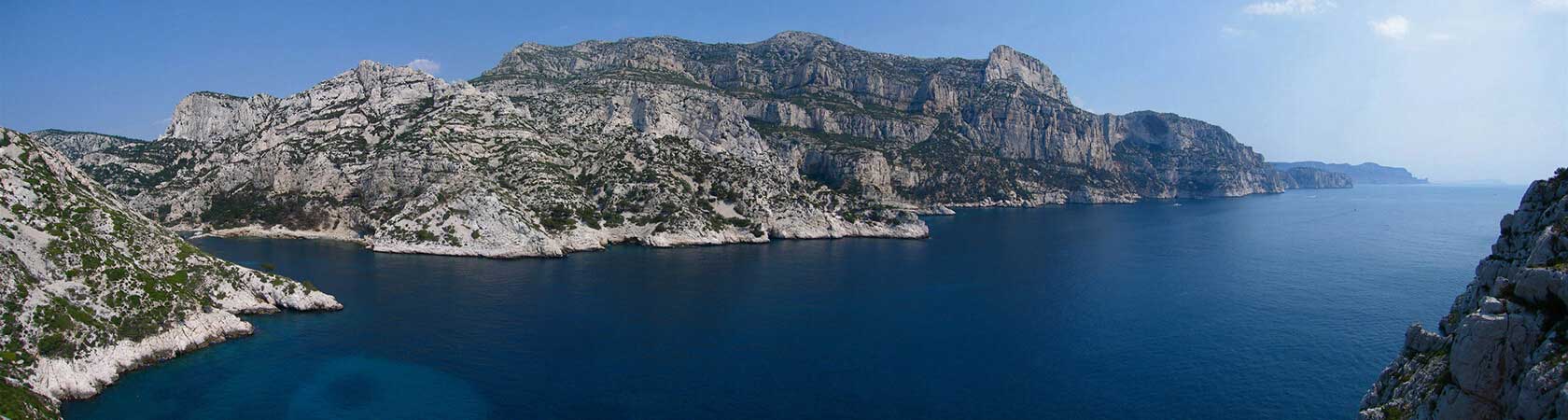
The Calanques of Marseille stretch over more than twenty kilometres of coastline between the village of Les Goudes, a district in the south-west of Marseille, and Cassis. It is one of the most remarkable sites in France, and a major area for natural resources and outdoor activities. These Calanques are Goélette Alliance's favourite stretch of water. In 2012, the Calanques massif became a National Park, to which Goélette Alliance has privileged access. The setting is majestic, between limestone cliffs overlooking wild coves and small former fishing ports where cabanons nestle - modest, typically Provençal dwellings.
Beyond the famous Grotte Cosquer (now closed to the public), other sea caves are part of our regular itineraries, such as the Grotte Bleue and the Grotte du Capelan.
The word ’calanque’ (from the Provençal ’calanco’) refers to a valley carved by a river and later reclaimed by the sea.
The countless fossils embedded in the limestone bear witness to a history that began more than a hundred million years ago, with sediment accumulating on the seabed, followed by an uplift during the Tertiary era, when the Alps were formed. Erosion has since deepened the fractures, giving rise to the rugged terrain seen today.
List of Calanques from West to East – Source Wikipedia: Calanque de Callelongue, Calanque de la Mounine, Calanque de Marseilleveyre, Calanque de Podestat, Calanque de l'Escu, Calanque de Sormiou, Calanque de la Triperie, Calanque de Morgiou, Calanque de Sugiton, Calanque du Devenson, Calanque de l'Oule, Calanque d'En-Vau, Calanque de Port-Pin, Calanque de Port-Miou
The Bay of Marseille and the Frioul Islands
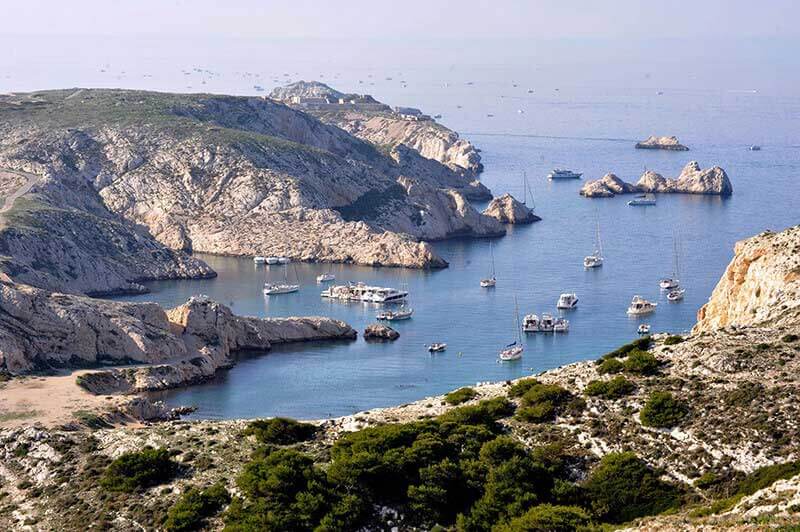
From L'Estaque to Les Goudes, via the Frioul archipelago. Pomègues, Ratonneau and the Château d'If.
"Marseille, to tell the truth, can only be loved this way: arriving by sea. In the early morning. At the hour when the sun, rising from behind the Marseilleveyre massif, embraces its hills and gives its old stones their rosy glow once more. This is Marseille as Protis the Phocaean first discovered it.
And it hardly matters if that is an exaggeration. Marseille always exaggerates.
That is its true nature. And, deep down, nothing has changed since that day. You need only arrive from Corsica by ferry to reconnect with this story. Or, more simply still, return from a night of fishing off the Estaque. When the harbour opens its arms to you, then, only then, do you discover the eternal meaning of this city. Welcome."
Jean-Claude Izzo, Marseille.
At the gates of Marseille, the Frioul Islands, four blocks of limestone swept by the mistral, hold the remnants of their past: the islands of Pomègues and Ratonneau were once the obligatory quarantine stop for all ships arriving from Africa and Asia.
As for the Château d'If, a magnificent fortress built by François I, it remains famous thanks to Alexandre Dumas's novel The Count of Monte Cristo, and watches over Île Degaby
Links about Marseille and the Bay – Wikipedia sources: The Frioul Archipelago, Pomègues Island, Ratonneau Island, Château d'If, L'Estaque, Le Vallon des Auffes, Les Goudes.
The Riou Archipelago
An exceptional site offering a panoramic view over the entire Calanques massif, from Île Maïre to Bec de l'Aigle.
We will show you a wild landscape within a nature reserve accessible only by boat, and offer anchorage in a special spot such as the Calanque de Monasterio, Fontagne or Pouars.
The National Park has established "no-take zones" in this area, where all forms of fishing are banned. Today, we can see the benefits: the fish we observe are more numerous, more varied, and larger in size.
These islands form a true sanctuary for many rare animal and plant species, and represent a natural heritage recognised at European level.
Île de Riou is also known as the "Island of Birds". It is a site of prime importance for the breeding of French seabirds such as the Scopoli's shearwater, the Yelkouan shearwater, and the European storm petrel.
The archipelago is also a historic site for underwater archaeology. It was here that Commander Cousteau and Professor Fernand Benoît organised, from 1952 onwards, the first underwater archaeological excavations directed from the surface. They discovered shipwrecks and their cargoes of Greco-Italic and Roman amphorae, the oldest of which date back to the early 2nd century BC.
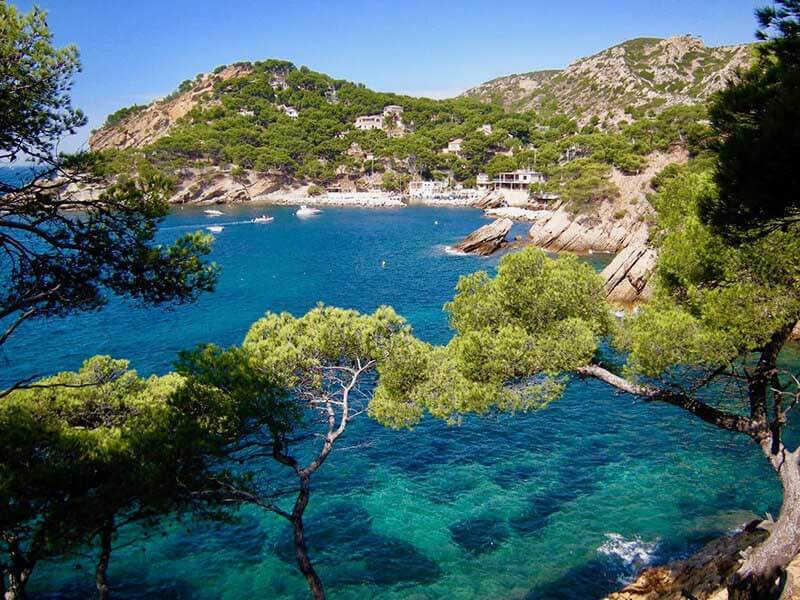
The Calanques of the Côte Bleue
The Côte Bleue, located to the west of Marseille, is the stretch of coastline running from L'Estaque to La Couronne. This "Côte Bleue" (Blue Coast), whose name refers to the colour of the waters surrounding the massif, is an ideally sheltered spot when the mistral blows.
The beaches are less well known than those of the Calanques of Marseille and Cassis, and are not part of the Calanques National Park. Even so, Marseillais are just as fond of the beaches to the west of the city as those to the east, and the luckiest among them own a cabanon there.
The calanques of the Côte Bleue are very popular with diving enthusiasts, who never miss one of the famous "oursinades" (sea urchin feasts).
There are few roads and access is fairly difficult, so exploring by sea remains the best way to enjoy this splendid coastline, with its remarkable views over the Bay of Marseille and the Frioul archipelago. The small ports of La Vesse, Niolon, Méjean, Figuières and La Redonne are typical of the spirit of the Calanques.
From Carry-le-Rouet to La Couronne, the coastline becomes less rugged and the seafront is more geared towards seaside tourism. It is at La Couronne that you will find the finest sandy beaches of the Côte Bleue.